PBT vs ABS Keycaps — What Actually Matters
PBT keycaps resist the greasy "shine" that ABS develops within months of daily use, staying matte for years — but material alone is a poor buying rule. A thick doubleshot ABS set (the material of premium GMK-style sets) outlasts thin, fuzzy-legend budget PBT; what actually decides longevity is legend method (doubleshot or dye-sub, which can never wear off) and wall thickness (~1.1–1.5mm typical, thicker = deeper sound), with material third.
What are PBT and ABS, actually?
They're the two plastics almost all keycaps are molded from. ABS (acrylonitrile butadiene styrene) is cheaper and easier to mold: it flows crisply into fine legend detail and takes bright, saturated colors, which is why it dominates both budget stock caps and premium colorway sets. Its drawback is softness — finger oils and friction polish the surface, and high-use keys (spacebar, home row, WASD) develop a visible greasy gloss within months to about a year of daily typing.
PBT (polybutylene terephthalate) is a harder, denser plastic with a lightly textured surface. It resists that polishing for years, and its typically thicker walls give a slightly deeper, more muted sound. The tradeoff: PBT is harder to mold crisply — which is why cheap PBT sets often have slightly fuzzy dye-sub legends, and why large PBT keys (especially the spacebar) can arrive faintly warped at the budget tier.
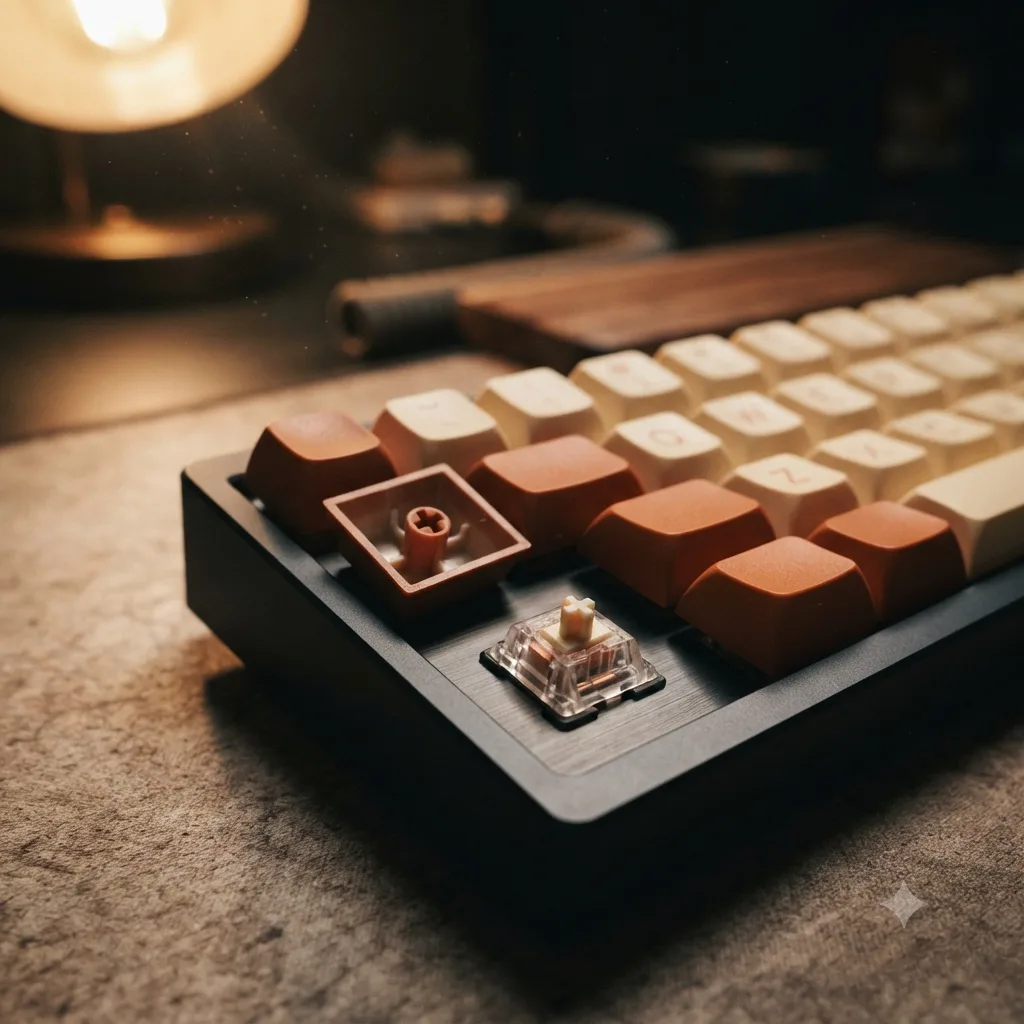
Isn't ABS the cheap plastic? The GMK nuance
No — this is the most common oversimplification in keycap buying. The most sought-after premium keycap sets in the hobby (GMK-style doubleshot sets) are ABS, chosen precisely because ABS molds sharp doubleshot legends and rich colors that PBT struggles to match. A thick (~1.5mm) doubleshot ABS cap feels solid, sounds good, and its legends can never wear off. It will still shine with use — that's material physics — but shine is cosmetic, not functional. The honest framing: ABS ≠ cheap and PBT ≠ premium; thickness and legend molding matter more than the material name on the box.
Legend methods decoded: which legends wear off?
How the letters are put on the cap decides whether they survive. Four methods, worst to best:
- Pad-printed: ink painted (often with a coating) on the surface. Wears visibly within months on high-use keys. Common on the cheapest boards.
- Laser-etched / laser-engraved: burned or marked into the surface. More durable than printing, but can fill with grime and still fade over long use.
- Dye-sublimated: dye driven into the plastic itself — the legend is part of the cap and cannot wear off. Effectively PBT-only (ABS can't take the heat), dark-on-light designs only, and it cannot do shine-through RGB.
- Doubleshot: the legend is a second piece of plastic molded through the cap — it cannot wear off, and a translucent legend plastic enables shine-through RGB. Works in ABS (common) and PBT (rarer, pricier).
Does thickness change the sound?
Yes, and more than most spec sheets admit. Keycap walls typically run about 1.1mm on thin stock caps up to roughly 1.5mm on thick enthusiast sets. Thicker walls mean more mass and less resonance, so the cap sounds deeper and feels more solid; thin caps sound higher-pitched and hollow. This is why a thick ABS set can sound "premium" while a thin PBT set sounds cheap — thickness is doing the work, not the material label. (Case, mounting style, and switches still shape overall sound more than caps do.)
PBT vs ABS at a glance
| Trait | ABS | PBT |
|---|---|---|
| Shine resistance | Glosses on high-use keys within months to ~1 year of daily use | Stays matte for years |
| Surface feel | Smooth, can get slick | Lightly textured, drier |
| Sound tendency | Slightly higher-pitched, "clacky" | Slightly deeper, more muted |
| Molding / colors | Easy to mold crisply; bright saturated colors; the material of premium GMK-style doubleshot sets | Harder to mold; cheap sets risk fuzzy legends and warped spacebars |
| Legend options | Pad-print, laser, doubleshot (incl. shine-through) | Dye-sub (can't wear, no shine-through) or doubleshot (rarer) |
| Typical wall thickness | ~1.1mm thin stock → ~1.5mm premium doubleshot | Often 1.3–1.5mm; budget sets vary |
| Honest verdict | Fine — even premium — if thick and doubleshot; will shine eventually | The durable default, if the legends are crisp and the spacebar is straight |
The honest buying rule
Doubleshot-or-dye-sub beats material religion. Rank your checklist: (1) legends that can't wear off — doubleshot or dye-sublimated; (2) thickness — closer to 1.5mm than 1.1mm; (3) then material — PBT if you hate shine, ABS if you want shine-through RGB or premium colorways. A thick doubleshot ABS set will outlast and outperform a thin, fuzzy-legend PBT set every time. Avoid only pad-printed legends and paper-thin caps.
Side note: keycap profile is the feel factor
Profile — the sculpted shape and height of the rows — changes feel more than material does. OEM (tall-ish, sculpted) is the common stock profile; Cherry is slightly lower and a frequent enthusiast favorite; SA is tall, retro, and deep-sounding but a bigger adjustment; XDA/DSA are uniform and flat, so every row feels the same. Profile is pure preference — but if a new set feels "wrong," the profile changed, not the plastic.
Which of our picks come with what
From our ranked picks: the Keychron V-series and K8 Pro ship with doubleshot PBT — the strongest stock combination (legends can't wear, material resists shine). The EPOMAKER TH80 Pro and NuPhy Air75 V2 also ship PBT caps. The Razer Huntsman V3 Pro uses doubleshot PBT on the gaming side. The RK Royal Kludge RK84 commonly ships ABS caps that will shine faster — a fair budget tradeoff, and any standard MX board's caps can be replaced later. The Logitech MX Mechanical uses ABS-type low-profile caps that aren't meant to be swapped — you're buying the appliance, not a platform. Note the Keychron C3 Pro's caps are ABS on some trims — check the exact model.
Related guides
Frequently Asked Questions
No. PBT resists shine and holds its texture for years, but thick doubleshot ABS — the material of premium GMK-style sets — sounds and feels excellent and its legends never wear off; it will still gloss with use. Meanwhile cheap thin PBT can have fuzzy legends and warped spacebars. Thickness and legend method (doubleshot or dye-sub) matter more than the material name alone.
With daily use, ABS typically develops visible gloss on the spacebar, home row, and WASD within a few months to about a year. The plastic is softer, so finger oils and friction polish its surface. PBT is harder and keeps its matte texture for years of the same use. Shine is cosmetic — it doesn't change how the switch registers.
Doubleshot molds the legend as a second piece of plastic through the cap, so it can never wear off and can be made translucent for shine-through RGB. Dye-sublimation dyes the legend into the plastic itself — it also can't wear off, but it's essentially a PBT-only process and can't do shine-through. Both beat pad-printed legends, which are painted on and wear away, and laser-etched legends, which sit between.
PBT has a higher melting point and shrinks less predictably, making it harder to mold crisply and to dye-sub sharply — doing it well costs more. Budget PBT sets often show slightly fuzzy dye-sub legends or warped larger keys, especially the spacebar. Well-made PBT (and well-made doubleshot ABS) avoids both problems.
Slightly. PBT caps are usually a bit thicker and the material is denser, so they tend to sound a touch deeper and more muted; ABS tends slightly higher-pitched and 'clackier.' Thickness is the bigger driver: caps in the roughly 1.1–1.5mm wall range sound deeper at the thick end regardless of material. Case, mount style, and switches still dominate overall sound.
Only with doubleshot PBT, which exists but is less common and costs more because PBT is harder to mold. Dye-sub — the usual PBT legend method — cannot do shine-through, since the legend is dye in solid plastic. Most shine-through sets are doubleshot ABS with translucent legend plastic. If RGB legends matter to you, check for 'doubleshot' plus 'shine-through' specifically.